Tell us about the job
Takes about a minute. No obligation.
A contractor quoting a water heater repair in Fayette County starts by ruling out the mundane causes before anything else. 97 severe weather events were recorded in Fayette County, Iowa between 2015 and 2024. That puts this area in the middle of the national range, where severe weather is real but not the grinding constant that shapes every service call. Sediment accumulation, a corroded anode rod, or a failing heating element are what a contractor finds in most units here. The weather load alone does not account for those, and a diagnosis that leans on it skips the inspection that would actually explain the failure.
Older plumbing and mechanical systems in this county have been replaced and replaced again since the houses around them were first built, and each generation of equipment leaves behind fittings, valves, and tank configurations that the next generation was never designed to match. Half the homes in Fayette County, Iowa were built in 1954 or earlier (2020-2024 ACS 5-year). A contractor opening a water heater here checks what the unit actually takes before committing to a repair scope, because a part that looks standard on the outside can turn out to be a size or thread pattern that current suppliers no longer stock. That gap between what the house has and what a distributor carries is where repair jobs in stock this old get longer or more expensive than the initial call suggested.
The Parts of a Water Heater a Contractor Checks During a Repair
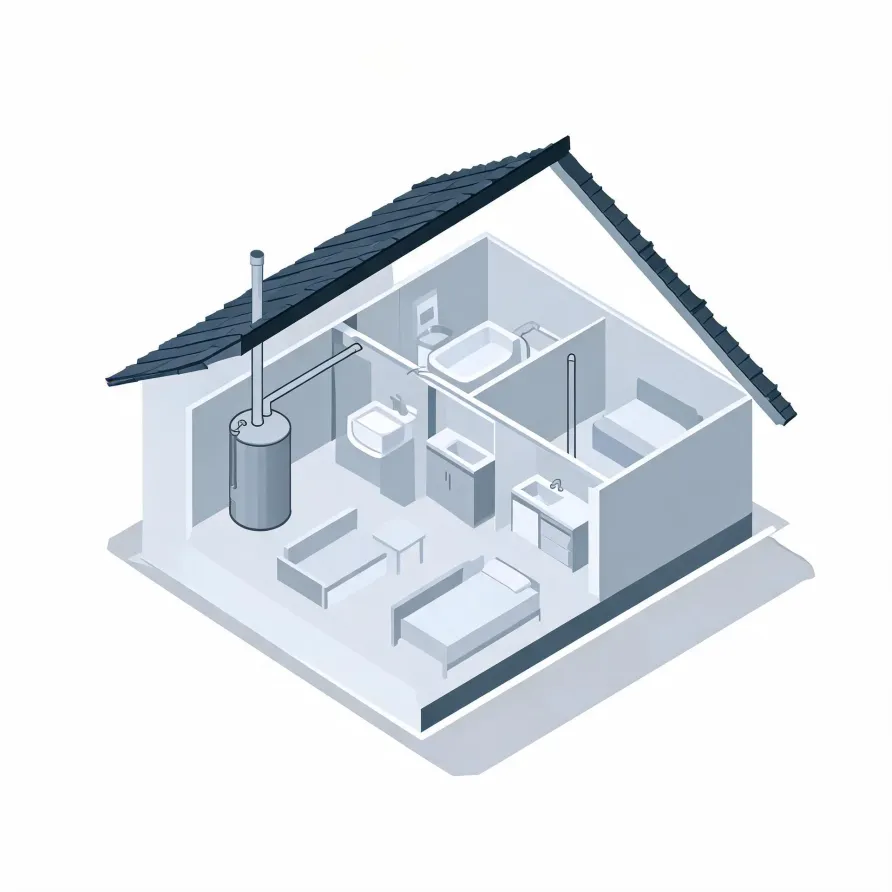
The tank itself is the piece most homeowners know: a large insulated cylinder that sits in a utility room, basement, or garage and holds a supply of heated water. When a tank corrodes or develops a leak, the tank is the source. The burner assembly or heating element sits at the base or inside the tank and is where failure shows up as no hot water or inconsistent temperatures.
The thermostat controls the target temperature and is where a contractor looks when the water runs too hot, too cold, or swings between both. The pressure relief valve mounts on the side of the tank and is a safety device that a contractor checks for signs of discharge or corrosion. The anode rod hangs inside the tank and slows internal rust; a depleted rod is a common finding when a tank shows early signs of deterioration.
The drawing shows a general layout of a water heater system, and a licensed contractor determines which components apply to the specific unit and setup in your home.
Get matched in Fayette CountyFayette County, Iowa, by the numbers
97 severe weather events were recorded in Fayette County, Iowa between 2015 and 2024.
NOAA National Centers for Environmental Information, Storm Events Database, bulk CSV export, events 2015-01-01 through 2024-12-31.Half the homes in Fayette County, Iowa were built in 1954 or earlier (2020-2024 ACS 5-year).
U.S. Census Bureau, 2020-2024 American Community Survey 5-Year EstimatesFayette County, Iowa holds 9,320 housing units (2020-2024 ACS 5-year).
U.S. Census Bureau, 2020-2024 American Community Survey 5-Year EstimatesOwners occupy 76.5% of the occupied homes in Fayette County, Iowa (2020-2024 ACS 5-year).
U.S. Census Bureau, 2020-2024 American Community Survey 5-Year EstimatesCodes & Standards Covering Water Heater Repair in Fayette County, Iowa1 sourced rules and standards
Licensing and Legal Requirements in Fayette County, Iowa
Iowa requires a state licence to install or repair HVAC, refrigeration, mechanical or plumbing systems, and to operate as a contractor, with exceptions listed in section 105.11.
Severe Weather Events in Fayette County
Extreme weather puts real stress on water heaters, forcing repeated recovery cycles and accelerating wear on components that might otherwise last years longer. How hard that pressure hits depends on where you are, and in Fayette County that makes water heater repair a locally shaped question.
97 severe weather events, 2015–2024. Source: NOAA National Centers for Environmental Information, Storm Events Database.