Tell us about the job
Takes about a minute. No obligation.
A contractor quoting a water heater repair in Clayton County starts with the equipment itself: how the components have aged, whether the anode rod has been replaced, and what the sediment layer at the tank bottom looks like. 119 severe weather events were recorded in Clayton County, Iowa between 2015 and 2024. That rate of severe weather is enough to put genuine stress on outdoor components and wiring, but water heater failures in this county more often trace to neglected maintenance than to weather events. A corroded anode rod or a failing heating element tells its own story, and the weather record alone does not write it.
Pipe fittings, anode rods, and control valves on a water heater tell a contractor what the system has been doing, but sourcing what the opened unit actually needs is where jobs in this county stall. Half the homes in Clayton County, Iowa were built in 1960 or earlier (2020-2024 ACS 5-year). The equipment running in those houses came in later, which means systems here are old enough that replacement parts run thin or require special ordering. A contractor who opens a unit and finds a failed thermostat or a corroded dip tube has to confirm the part is still available before a repair scope can be set.
The Parts of a Water Heater a Contractor Checks First
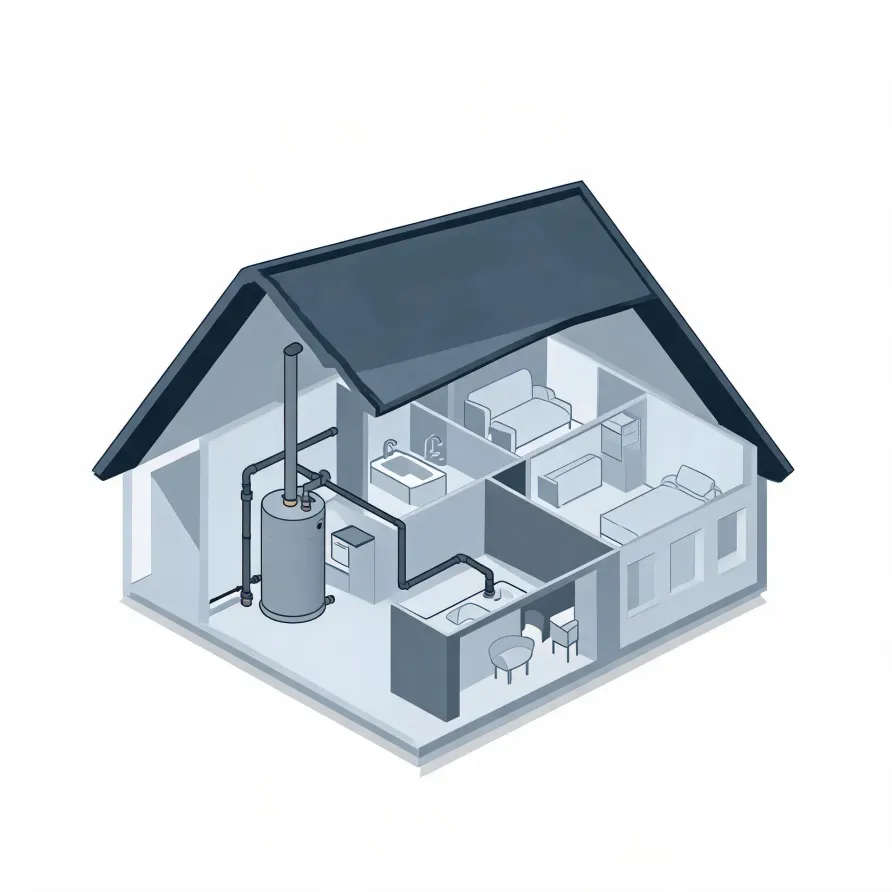
The tank is the piece a homeowner notices: a tall insulated vessel that sits in a utility room, basement, or closet and holds a supply of water at a set temperature. The burner or heating element at its base or interior is what a contractor looks at when the water runs cold or the unit cycles strangely.
The thermostat controls when heat kicks on, and the pressure relief valve sits on the side of the tank as a safety device that opens if pressure climbs too high. The anode rod runs down inside the tank and slows corrosion; when it is depleted, the tank itself starts to take the damage.
The drawing shows a general layout of the system, and a licensed contractor determines which components apply to your specific setup.
Get matched in Clayton CountyClayton County, Iowa, by the numbers
119 severe weather events were recorded in Clayton County, Iowa between 2015 and 2024.
NOAA National Centers for Environmental Information, Storm Events Database, bulk CSV export, events 2015-01-01 through 2024-12-31.Half the homes in Clayton County, Iowa were built in 1960 or earlier (2020-2024 ACS 5-year).
U.S. Census Bureau, 2020-2024 American Community Survey 5-Year EstimatesClayton County, Iowa holds 8,796 housing units (2020-2024 ACS 5-year).
U.S. Census Bureau, 2020-2024 American Community Survey 5-Year EstimatesOwners occupy 78.0% of the occupied homes in Clayton County, Iowa (2020-2024 ACS 5-year).
U.S. Census Bureau, 2020-2024 American Community Survey 5-Year EstimatesCodes & Standards Governing Water Heater Repair in Clayton County, Iowa1 sourced rules and standards
Licensing and Legal Requirements in Clayton County, Iowa
Iowa requires a state licence to install or repair HVAC, refrigeration, mechanical or plumbing systems, and to operate as a contractor, with exceptions listed in section 105.11.
Severe Weather Events in Clayton County
Extreme weather puts water heaters under stress: temperature swings, power surges, and flooding all shorten equipment life and drive repair calls. How hard the weather pushes here shapes how hard the equipment works, and that makes it a local factor worth seeing.
119 severe weather events, 2015–2024. Source: NOAA National Centers for Environmental Information, Storm Events Database.