Tell us about the job
Takes about a minute. No obligation.
A water heater in Dallas County has not been sitting in a mild environment. 185 severe weather events were recorded in Dallas County, Iowa between 2015 and 2024. At that rate, severe weather is part of the normal operating life of equipment here, and a contractor working a repair will check whether components like the anode rod, pressure relief valve, or tank connections have been carrying weather-driven stress before settling on a cause. That changes what gets inspected first and what parts get ordered.
Houses built recently enough to have been designed around modern water heater loads do not hand contractors the infrastructure surprises that older stock does. Half the homes in Dallas County, Iowa were built in 2006 or earlier (2020-2024 ACS 5-year). That recency means a contractor opening a water heater here is dealing with the unit itself: the anode rod, the heating element, the thermostat, the pressure relief valve. The plumbing connections and electrical supply serving it were put in for something close to what sits there now, so the repair scope stays inside the equipment rather than spreading into the house around it.
The Parts of a Water Heater a Contractor Checks During a Repair
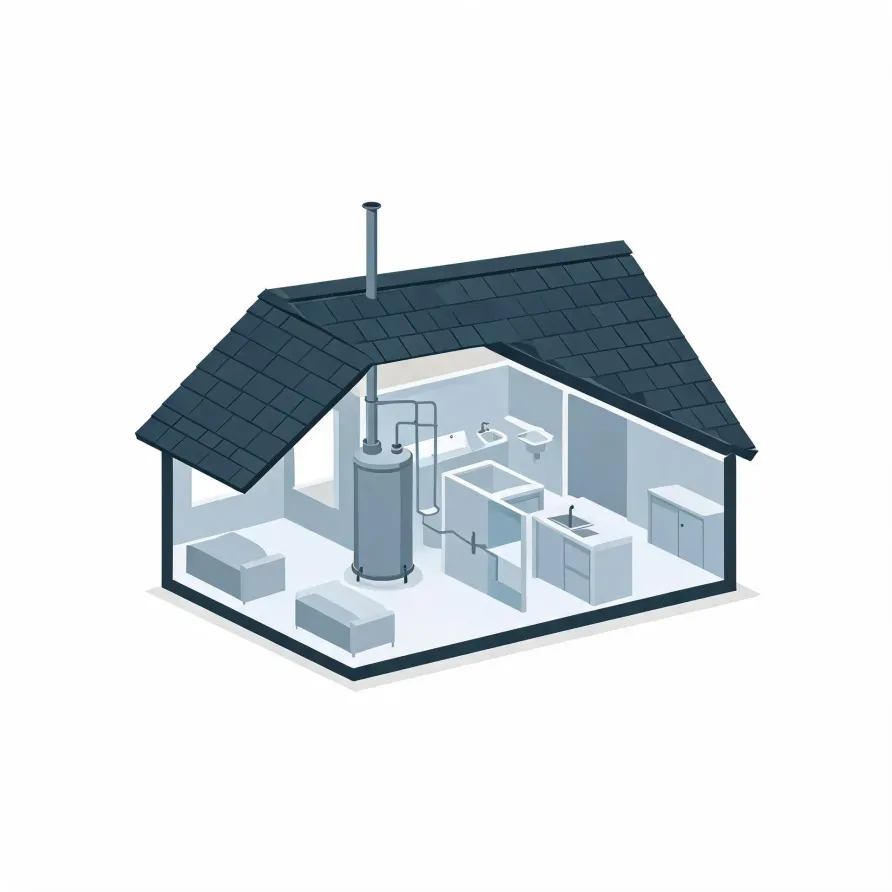
The tank is what most homeowners picture first: a large insulated cylinder that sits in a utility room, basement, or garage and holds a supply of hot water ready for use. Inside it, a heating element or burner assembly applies heat to the stored water, and when either of those fails, the tank stops producing hot water or stops maintaining temperature.
The thermostat, which is mounted on or near the tank, reads the water temperature and signals the heating element or burner to cycle on and off. A pressure relief valve sits on the tank's side or top and releases if pressure builds beyond a safe level. The anode rod hangs inside the tank and slows corrosion of the tank walls, and its condition is one of the first things a contractor checks when a tank shows signs of rust or sediment.
The drawing shows a general layout of a water heater system, and a licensed contractor determines what applies to the specific unit and installation in your home.
Get matched in Dallas CountyDallas County, Iowa, by the numbers
185 severe weather events were recorded in Dallas County, Iowa between 2015 and 2024.
NOAA National Centers for Environmental Information, Storm Events Database, bulk CSV export, events 2015-01-01 through 2024-12-31.Half the homes in Dallas County, Iowa were built in 2006 or earlier (2020-2024 ACS 5-year).
U.S. Census Bureau, 2020-2024 American Community Survey 5-Year EstimatesDallas County, Iowa holds 44,804 housing units (2020-2024 ACS 5-year).
U.S. Census Bureau, 2020-2024 American Community Survey 5-Year EstimatesOwners occupy 69.0% of the occupied homes in Dallas County, Iowa (2020-2024 ACS 5-year).
U.S. Census Bureau, 2020-2024 American Community Survey 5-Year EstimatesCodes & Standards Governing Water Heater Repair in Dallas County, Iowa1 sourced rules and standards
Licensing and Legal Requirements in Dallas County, Iowa
Iowa requires a state licence to install or repair HVAC, refrigeration, mechanical or plumbing systems, and to operate as a contractor, with exceptions listed in section 105.11.
Severe Weather Events in Dallas County
Extreme weather puts a hard load on water heaters, forcing them to work outside the conditions they were built for. How much of that stress a unit carries depends on what the local climate actually delivers.
185 severe weather events, 2015–2024. Source: NOAA National Centers for Environmental Information, Storm Events Database.