Tell us about the job
Takes about a minute. No obligation.
A contractor quoting a water heater installation in Clay County has to account for what the climate regularly puts on a system, because sizing and setup that work in a quieter area fall short here. 141 severe weather events were recorded in Clay County, Iowa between 2015 and 2024. At that rate, severe weather is a standing condition rather than an occasional disruption, and a unit installed without that in mind carries a harder load than its specs assumed. Sediment shifts, pressure fluctuations, and stress on connections all move faster under those conditions. A contractor who knows this area sizes the unit and specifies the fittings accordingly.
The electrical service in an older Clay County home was sized for the demands of its era, and a new water heater draws power against a different standard than the wiring was planned around. Half the homes in Clay County, Iowa were built in 1967 or earlier (2020-2024 ACS 5-year). A contractor installing a water heater in stock like this checks the panel and the existing circuit before anything else, because that is where the job either proceeds cleanly or picks up scope. The equipment itself fits. Whether the electrical does is the open question.
The Parts of a Water Heater an HVAC Contractor Works Around
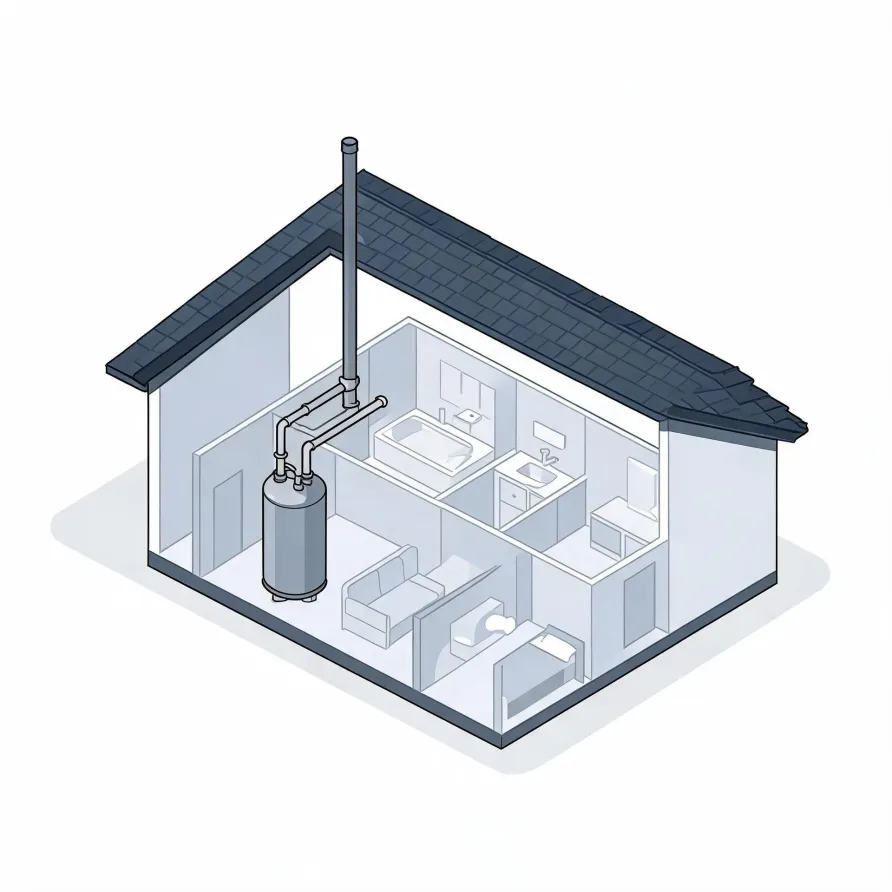
The tank is the piece a homeowner sees first, usually standing in a utility room, basement, or garage closet. It holds and heats the water supply for the house. Connected to it are the cold-water inlet at the top and the hot-water outlet that feeds every fixture downstream.
The pressure relief valve sits on the side of the tank and is the system's primary safety device, releasing pressure if the tank runs too high. A drain valve near the base, along with the anode rod suspended inside the tank, round out what a contractor accounts for when fitting HVAC work into the same mechanical space.
The drawing shows a general layout, and a licensed contractor determines what applies to the specific setup in your home.
Get matched in Clay CountyClay County, Iowa, by the numbers
141 severe weather events were recorded in Clay County, Iowa between 2015 and 2024.
NOAA National Centers for Environmental Information, Storm Events Database, bulk CSV export, events 2015-01-01 through 2024-12-31.Half the homes in Clay County, Iowa were built in 1967 or earlier (2020-2024 ACS 5-year).
U.S. Census Bureau, 2020-2024 American Community Survey 5-Year EstimatesClay County, Iowa holds 8,157 housing units (2020-2024 ACS 5-year).
U.S. Census Bureau, 2020-2024 American Community Survey 5-Year EstimatesOwners occupy 73.3% of the occupied homes in Clay County, Iowa (2020-2024 ACS 5-year).
U.S. Census Bureau, 2020-2024 American Community Survey 5-Year EstimatesWater Heater Installation Rules for Clay County, Iowa1 codes and standards
Licensing and Legal Requirements in Clay County, Iowa
Iowa requires a state licence to install or repair HVAC, refrigeration, mechanical or plumbing systems, and to operate as a contractor, with exceptions listed in section 105.11.
Severe Weather Events in Clay County
Water heaters work harder when outdoor conditions swing wide, and Iowa weather puts real demand on equipment year after year. How much strain a unit absorbs over its life is a local question, and the record below puts Clay County's conditions in plain view.
141 severe weather events, 2015–2024. Source: NOAA National Centers for Environmental Information, Storm Events Database.