Tell us about the job
Takes about a minute. No obligation.
A contractor quoting a water heater installation in Lee County has to account for what the equipment will actually run against. 142 severe weather events were recorded in Lee County, Iowa between 2015 and 2024. At that rate, severe weather is a standing condition here, and it shapes how a unit is sized, where it is positioned, and how the installation is secured. A water heater that fits a calmer county on paper may be undersized for what Lee County puts it through over the years of its working life.
Ductwork and venting paths laid into a house generations ago were sized for equipment that no longer exists, and a new water heater has to work with whatever those passages actually allow. Half the homes in Lee County, Iowa were built in 1960 or earlier (2020-2024 ACS 5-year). A contractor pricing an installation here measures the existing flue routing and exhaust clearances before settling on a unit, because what the house already contains decides which models will fit and which will not. A tight or mismatched venting run can shift the job considerably, and no amount of looking at the new equipment answers that question.
What a Water Heater Installation Covers
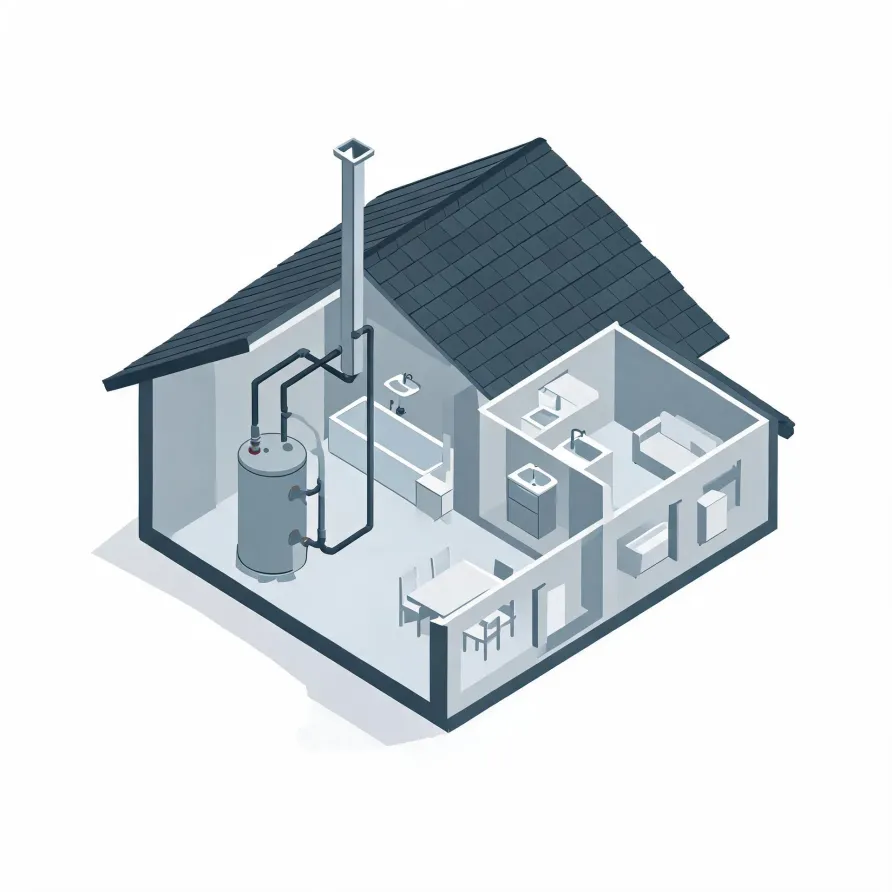
The tank or tankless unit is the core of the system. A tank unit sits in a utility room, basement, or garage and holds a ready supply of hot water. A tankless unit mounts on a wall and heats water as it moves through, so it takes up far less floor space.
The pressure relief valve attaches directly to the tank and opens if pressure or temperature climbs too high. The supply and outlet pipes connect at the top, bringing cold water in and sending hot water out to every fixture in the house. A drain valve at the base gives a contractor access to flush sediment from the tank.
The drawing shows a general layout, and a licensed contractor determines what applies to this particular house.
Get matched in Lee CountyLee County, Iowa, by the numbers
142 severe weather events were recorded in Lee County, Iowa between 2015 and 2024.
NOAA National Centers for Environmental Information, Storm Events Database, bulk CSV export, events 2015-01-01 through 2024-12-31.Half the homes in Lee County, Iowa were built in 1960 or earlier (2020-2024 ACS 5-year).
U.S. Census Bureau, 2020-2024 American Community Survey 5-Year EstimatesLee County, Iowa holds 15,794 housing units (2020-2024 ACS 5-year).
U.S. Census Bureau, 2020-2024 American Community Survey 5-Year EstimatesOwners occupy 76.3% of the occupied homes in Lee County, Iowa (2020-2024 ACS 5-year).
U.S. Census Bureau, 2020-2024 American Community Survey 5-Year EstimatesWater Heater Installation Rules for Lee County, Iowa1 sourced standards and codes
What Lee County, Iowa Requires for HVAC Installation
Iowa requires a state licence to install or repair HVAC, refrigeration, mechanical or plumbing systems, and to operate as a contractor, with exceptions listed in section 105.11.
Severe Weather Events in Lee County
Weather puts a measurable load on water heating equipment, and that load varies by location. How hard the climate pushes here shapes what a water heater is asked to do and how long it holds up doing it.
142 severe weather events, 2015–2024. Source: NOAA National Centers for Environmental Information, Storm Events Database.